BLOG
>
Blog
What Payment Processors Will Work With Sweepstakes Casinos?
A guide for sweepstakes and social casino operators: which provider types accept the model, what they review, and how to build a payment stack that holds up as state law changes.
Elizabeth Balash
11/13/2026

5
MIN READ
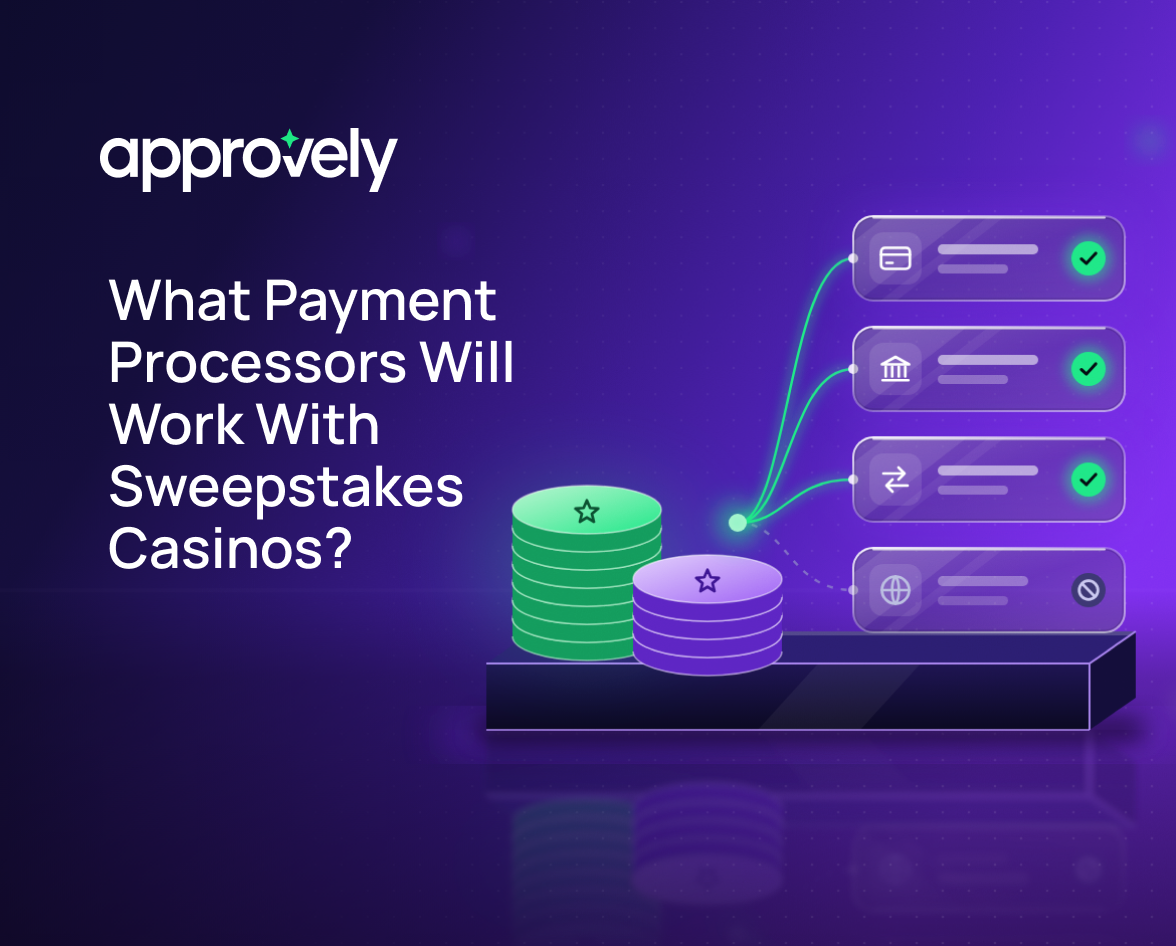
What Payment Processors Will Work With Sweepstakes Casinos?
A guide for sweepstakes and social casino operators: which provider types accept the model, what they review, and how to build a payment stack that holds up as state law changes.
Sweepstakes and social casino platforms run on a promotional model. Players buy Gold Coins for entertainment play, receive Sweeps Coins as a free bonus or through a free alternative method of entry, and can redeem eligible Sweeps Coin winnings for prizes.
In many states, that structure sits outside gambling law. Payment providers often read it differently. Mainstream processors list sweepstakes next to casino games on their prohibited lists, card issuers frequently treat coin purchases like wagers, and in 2026 several state bans began naming payment processors directly.
For an operator, the useful question is which providers can support the model over the long term, with settlement, risk controls, and compliance that stay in place when the rules change.
This guide covers the provider types that work with sweepstakes casinos, what their underwriters review, and how to structure a payment stack that keeps deposits and redemptions moving.
Why Most Payment Processors Turn Sweepstakes Casinos Away
The first wall most operators hit is the payment aggregator. Aggregators onboard thousands of merchants under one master account, so they write blanket rules for categories they don't want to underwrite one by one. Some businesses prohibit and restrict businesses, including sweepstakes and contests with a monetary or material prize, as a category it can't support. An operator that signs up anyway usually finds out at the first risk review, when the account is closed and funds are held.
PayPal leaves a narrow door open. PayPal's Acceptable Use Policy requires pre-approval for sweepstakes and other prize-based activities, and limits that approval to cases where the operator and its customers are located only in jurisdictions where the activity is legal. The Braintree Acceptable Use Policy lists sweepstakes under gambling and allows exceptions only with prior written approval. For a US-wide brand operating while state law keeps moving, those conditions are hard to meet and harder to keep meeting.
Behind those policies sit four practical concerns that any underwriter will raise:
- Classification. Issuers can't easily tell a Gold Coin purchase from a wager, so many treat both the same way and decline.
- Dispute exposure. Coin bundles are digital, instant, and easy to regret, which makes friendly fraud a constant pressure on dispute ratios.
- Legal liability. Newer state bans extend liability past the operator to the businesses that support it, including payment processors.
- Network monitoring. Visa and Mastercard both run programs that watch gambling-coded merchants and their dispute and fraud levels closely.
Sweepstakes payments in 2026: the numbers behind processor caution
11 states have enacted statutory bans on online sweepstakes casinos, with Oklahoma's taking effect on November 1, 2026.
Up to $25,000 per violation: California's AB 831 makes it unlawful for a financial institution or payment processor to knowingly and willfully aid an online sweepstakes game, with misdemeanor penalties of up to one year in jail.
June 30, 2025: Mastercard introduced its gaming and gambling monitoring program for US merchants processing under MCCs 7800, 7801, 7802, 7995 and 9406.
1.5%: the Visa Acquirer Monitoring Program (VAMP) threshold for an excessive merchant from April 1, 2026, down from 2.2% (see our breakdown of what full VAMP enforcement means for regulated merchants).
Who Processes Sweepstakes Payments? Provider Types Compared
There isn't one "sweepstakes processor." Operators that run reliably at scale combine several provider types, each with a different appetite for the model. The table below summarizes where each one stands in late 2026.
In practice, a payment processor for a social casino is rarely a single company. Most established operators pair a specialized card acquirer with one or two bank-based rails, then run redemptions on a separate payout rail. If you are moving off an aggregator, our comparison of Stripe alternatives for regulated businesses covers what changes when you switch to a dedicated merchant account.
How Sweepstakes Purchases Get Coded, and Why It Decides Your Approval Rate
Every card transaction carries a merchant category code (MCC) that tells the issuing bank what kind of business it is paying. MCC 7995 covers betting and casino gambling. Many issuers decline 7995 transactions by default, regardless of whether the merchant is licensed or lawful, so a sweepstakes brand coded as 7995 inherits gambling-level decline rates on Gold Coin purchases.
Your acquirer assigns the MCC based on how your business works and how it presents. According to Track360's 2026 operator guide, brands with "casino" in the domain and a deposit page that looks like a regulated sportsbook are more likely to be coded 7995, while brands with clear social gaming presentation and a Gold Coin purchase descriptor are more often coded under digital goods (5816) or skill and arcade gaming (7994). Skill-based platforms face a similar question, which we cover in our piece on why fantasy sports startups struggle with merchant account acquisition.
The code has to match how your product actually works. A provider that promises a cleaner code without reviewing your model is a risk to you, because miscoding can lead to network penalties and account termination. A better outcome comes from accurate coding, a recognizable billing descriptor, and routing that sends each purchase to the rail most likely to approve it. Our deep dive on improving authorization rates explains how those pieces work together.
Running a sweepstakes or social casino platform?
Approvely reviews your model, your state footprint, and your payment mix together, so card acceptance, bank rails, dispute controls, and settlement are set up as one system from day one.
What a Sweepstakes-Ready Processor Will Review
Providers that do support sweepstakes casinos underwrite the whole operation, not only the payment flow. Expect questions in six areas, and have the documents ready before the first call.
1. Your sweepstakes structure and legal opinion
Underwriters want to see that no purchase is necessary to play for prizes, that a free alternative method of entry exists and works, and that Gold Coins and Sweeps Coins are kept separate in both the product and the official rules. Most will ask for a legal opinion from gaming counsel covering the dual-currency model in the states you serve.
2. State geofencing and exit plans
With bans now in place across 11 states, processors check that you block restricted states at sign-up, at purchase and at redemption, and that geolocation is enforced rather than self-declared. They will also ask how quickly you can exit a state. Several bans took effect the day they were signed, and as DLA Piper's March 2026 analysis points out, some newer laws reach further than California's.
3. KYC, age verification and AML controls
Identity and age checks should happen before any prize redemption, with sanctions screening and monitoring for unusual purchase and redemption patterns. A processor that carries your volume is relying on these controls to keep its own compliance position intact.
4. Chargeback and dispute controls
Coin purchases attract friendly fraud: a player buys a bundle, has a losing session, and disputes the charge. With VAMP at 1.5% and Mastercard monitoring gambling-coded merchants, underwriters look for clear descriptors, purchase limits and velocity rules, 3D Secure on higher-risk purchases, pre-dispute alerts and a representment process. Our guide to reducing chargebacks covers each control in detail, and our post on game subscription payment processing shows how the same dispute drivers play out across gaming.
5. Redemption and payout rails
Who processes sweepstakes payments on the way out matters as much as on the way in. Redemptions usually run on ACH push, gift cards or checks, with crypto as an option for some operators. Processors want payouts kept separate from deposits, reconciled to verified players, and paid only to accounts in the player's own name.
6. Reserves, settlement timing and liquidity
Card acquirers commonly hold a rolling reserve against future disputes. Track360 estimates 5% to 10% held for 90 to 180 days, which ties up $250,000 to $500,000 on $5 million in monthly volume. Settlement speed affects whether you can fund redemptions on time, so ask for reserve and settlement terms in writing, along with the conditions for reducing the reserve as your history builds.
Building a Payment Stack That Holds Up When the Rules Change
A single card rail is the weakest setup for a sweepstakes casino. When issuers tighten rules on gambling-coded transactions, decline rates can rise quickly. Track360 estimates that operators routing across several rails hold 88% to 93% authorization during those periods, compared with 60% to 70% for operators relying on one card integration. Each rail has a role:
Source: Track360, Sweepstakes Casino Payment Processors 2026. Figures are industry estimates and vary by provider, volume and risk profile.
The rails only help if they share one view of risk. When card, bank, and payout data sit with different vendors, dispute ratios, redemption patterns, and reserve balances are hard to see in time to act. Operators that connect payments, fraud monitoring, compliance and settlement in one place can change routing or exit a state without losing visibility of their money. That is the approach behind Approvely's infrastructure for iGaming and regulated gaming operators.
Sweepstakes Payment Readiness Checklist
Before you speak to a processor, confirm you can show each of the following:
- A current legal opinion covering your dual-currency model and alternative method of entry
- A list of blocked states, enforced by geolocation at sign-up, purchase and redemption
- Official sweepstakes rules, linked from the purchase page
- A billing descriptor that names your brand and the coin purchase
- Per-player purchase limits and velocity rules
- KYC and age verification before any redemption
- Dispute alerts and a documented representment process
- At least two deposit rails and a separate redemption rail
- Reserve and settlement terms agreed in writing
- A plan to stop sales in a state within days of a new law
Sweepstakes Casino Payment Processor: Frequently Asked Questions
1. What payment processors work with sweepstakes casinos?
Specialized acquirers and payment infrastructure providers that underwrite regulated gaming, plus pay-by-bank, ACH, and some crypto providers. Mainstream aggregators prohibit sweepstakes with prizes, and others require prior approval.
2. Can I use Stripe as a payment processor for a social casino?
Not if players can win prizes. Stripe's prohibited list includes sweepstakes and contests with a monetary or material prize. A purely free-to-play social casino with no prize redemption is a different case, but you should confirm with Stripe before launch.
3. Who processes sweepstakes payments for prize redemptions?
Redemptions usually run on ACH push payouts, gift card providers or checks, sometimes with crypto payouts. They should sit on a separate rail from deposits and be paid only to identity-verified players.
4. Does PayPal accept sweepstakes casino payments?
Only with pre-approval, and only where the operator and its customers are located in jurisdictions that permit the activity. With 11 states now banning online sweepstakes casinos, that condition is difficult for a US-wide brand to meet.
5. What MCC do sweepstakes casinos use?
It depends on how the acquirer classifies the business. Some sweepstakes brands are coded 7995 (betting and casino gambling), while others are coded under digital goods (5816) or skill and arcade gaming (7994). The code must reflect how the product actually works.
6. Can a payment processor be liable under state sweepstakes bans?
Yes, in some states. California's AB 831 applies to financial institutions and payment processors that knowingly and willfully aid an online sweepstakes game, which is one reason processors now review state geofencing closely.
This article is for general information and isn't legal advice. Sweepstakes law changes quickly, so confirm your obligations with qualified gaming counsel.
Payment infrastructure built for regulated gaming
Approvely connects payments, risk management, compliance, and liquidity in one platform: a 96.43% card acceptance rate, a 98.05% chargeback protection rate, same-day onboarding, go-live in 3 to 5 business days, and US-based support.
Share this post


Blog