BLOG
>
Blog
Sports Betting Payment Processing: What Sportsbooks Need in 2026
See what sportsbooks need for reliable sports betting payment processing in 2026: gateway requirements, chargeback controls, and payout rails.
Elizabeth Balash
7/28/2026
.svg)
5
MIN READ
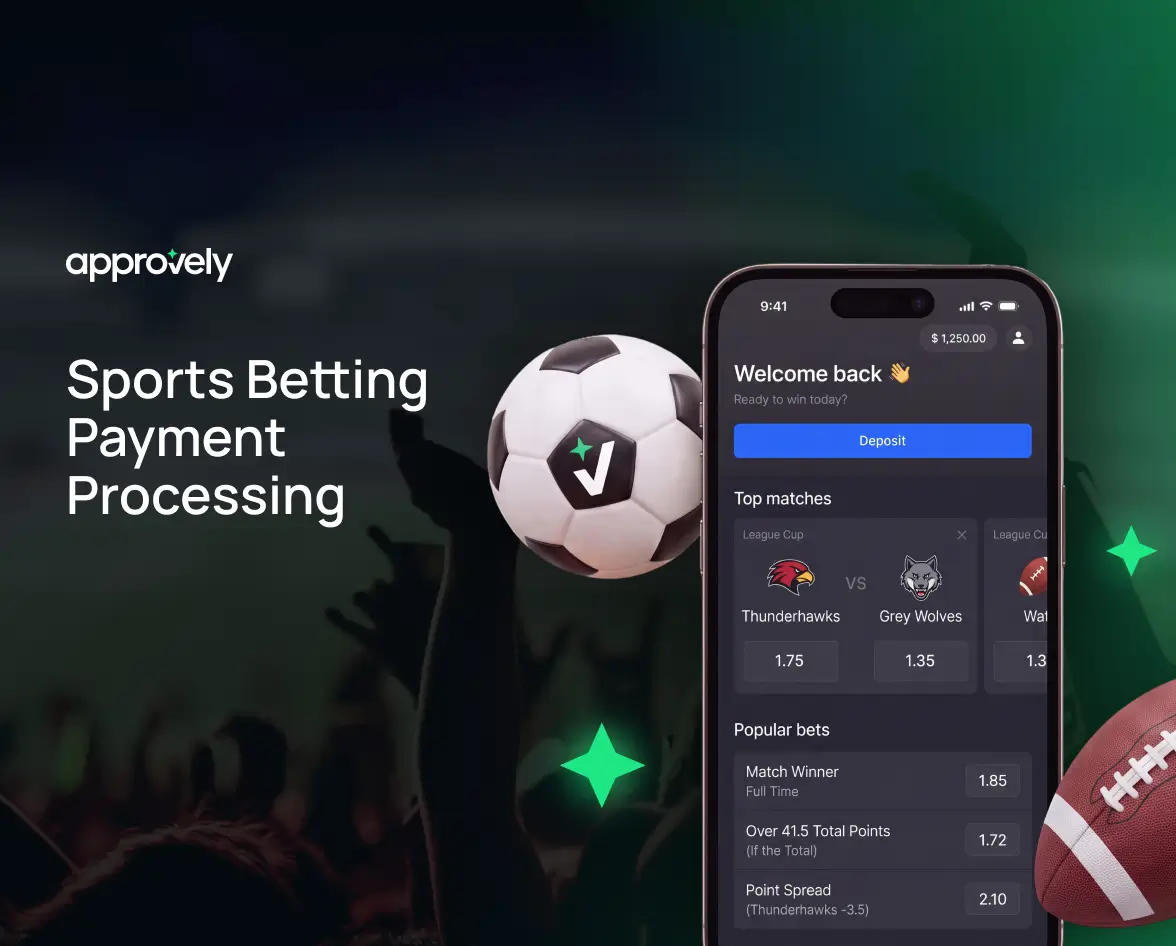
Sports betting is legal and live in 38 states plus Washington, D.C., and the industry helped push U.S. commercial gaming revenue past $78 billion in 2025, a record. That growth looks great on a slide deck. It looks very different from the payments desk, where every one of those states has its own licensing rules, every card network treats sportsbooks as MCC 7995 gambling risk, and every bettor expects deposits to clear instantly and payouts to land even faster.
Sports betting payment processing in 2026 comes down to four things: a gateway built to handle MCC 7995 without constant declines, chargeback and fraud controls tuned for how bettors actually behave, payout rails fast enough to keep players from churning to a competitor, and compliance flexibility that scales as sportsbooks launch state by state.
This guide walks through what a real sportsbook payment gateway needs to deliver, where most processors fall short, and what "betting payment solutions" actually means once you get past the marketing language.
What Makes Sports Betting Payment Processing Different From Standard eCommerce?
A retail checkout and a sportsbook cashier look similar on the surface: card in, transaction out. Underneath, they're not close.
Sportsbooks operate under MCC 7995, the merchant category code card networks assign to gambling and gaming. That single classification triggers stricter issuer scrutiny on every transaction, regardless of how clean an individual bettor's history looks. Layer on state-by-state licensing, mandatory KYC and age verification before a player can fund an account, and a customer base that includes people disputing losing bets, and you've got a payment environment that standard processors simply aren't built to handle.
The dispute dynamic is the part most new operators underestimate. A bettor who loses money has a direct financial incentive to dispute the charge, which is a very different risk profile than a retail customer disputing a late package. That's before accounting for bonus abuse, multi-accounting, and the identity fraud that gambling promotions tend to attract.
What Does a Sportsbook Payment Gateway Actually Need to Deliver in 2026?
Strip away the buzzwords and a sportsbook payment gateway needs to do a handful of things well, consistently, at volume:
- Multi-rail deposits and payouts: cards, ACH, Pay by Bank, and digital wallets like PayPal and Venmo, so bettors can fund and withdraw however they prefer
- Instant payouts: funds settling in minutes rather than days, since slow withdrawals are one of the fastest ways to lose a player to a competitor
- Built-in KYC and AML compliance: identity and age verification woven into onboarding, not bolted on afterward
- Fraud prevention tuned for gambling-specific patterns like bonus abuse and account cycling, not generic eCommerce fraud rules
- Chargeback protection that accounts for the elevated dispute rate baked into the vertical
- Improved authorization rates through smart routing, since MCC 7995 already pushes issuers toward caution
At Approvely, sportsbooks processing through our gaming infrastructure see roughly 91.49% approval rates and a 20% reduction in chargebacks compared to generic high-risk setups, largely because deposits and payouts run through a U.S. acquiring bank network built specifically around gambling risk rather than retail risk.
From Our Practice: Gaming operators on our platform get zero-liability chargeback coverage on approved transactions. If a bettor disputes a charge that was already cleared, the operator doesn't issue a refund or fight the case alone. Approvely and its banking partners absorb that liability directly, which changes the economics of running a sportsbook at scale.
How Does Live and Microbetting Change the Risk Calculation?
Live, in-game betting now accounts for a majority of U.S. sports wagering activity, and that shift has quietly broken the risk models most payment systems were built on. Traditional fraud tools score risk once per session. Microbetting requires scoring it continuously, because a bettor's deposit pattern in minute one can look nothing like their pattern fifteen minutes later.
Fraud rings have adapted accordingly. Instead of one large suspicious transaction, they run small test deposits to "warm up" cards, cycle through synthetic identities quickly, and exploit the brief latency window before in-game odds update. Banks often misread rapid, repeated deposits as suspicious even when the bettor is completely legitimate, which means a payment stack tuned for slower, session-based betting will generate false declines right when engagement is highest. Approvely's own breakdown of microbetting's payment strain goes deeper into how real-time risk scoring needs to work at this pace.
Traditional Processor vs. Sportsbook-Built Infrastructure
What Compliance and Licensing Realities Should Sportsbooks Plan Around?
Every state that legalizes sports betting sets its own licensing, tax, and reporting requirements, and that patchwork is the single biggest operational headache for any operator trying to scale past one jurisdiction. A payment partner that only understands one state's rules becomes a bottleneck the moment a sportsbook expands.
Card networks add another layer. Visa and Mastercard both run merchant monitoring programs that track chargeback ratios industry-wide, and gambling operators sit closer to those thresholds by default.
Approvely's recent look at Visa's Acquirer Monitoring Program (VAMP) covers what full enforcement means for regulated merchants, sportsbooks included. On top of state and network requirements, every U.S. sportsbook also pays a federal excise tax on total handle, not just revenue, which makes clean, well-categorized transaction data a compliance necessity rather than a nice-to-have.
Already Live and Fighting Declines?
If a sportsbook is already operating and losing revenue to declined deposits or slow payouts, the fix usually isn't a full platform migration. It's routing. A conversation about current approval rates, chargeback ratio, and payout speed can usually identify the gap within a day. Talk to our team about what's actually causing the friction.
What Payment Methods Do Bettors Actually Expect in 2026?
Card deposits remain the default, but they're no longer the whole picture. Bettors increasingly expect ACH and Pay by Bank options for larger transactions, PayPal and Venmo for fast, familiar deposits and withdrawals, and a growing number expect stablecoin and crypto rails to be available, particularly on crypto-forward platforms. Approvely's crypto infrastructure supports USDC-compatible payouts alongside traditional card and bank rails, which lets operators offer modern payment options without maintaining a second, disconnected payment stack.
Common Mistakes Sportsbooks Make With Payment Processing
- Choosing a processor based on rate alone, without checking whether they actually support MCC 7995 long-term
- Treating payouts as an afterthought until slow withdrawals start driving player churn
- Running fraud detection that scores risk once per session instead of continuously, which breaks down under live betting volume
- Expanding into a new state without confirming the payment partner can support that state's licensing requirements
- Letting chargeback ratios climb without a protection structure in place, risking enrollment in card network monitoring programs
FAQs: Sports Betting Payment Processing
What is a sportsbook payment gateway?
A sportsbook payment gateway is the infrastructure that processes deposits and withdrawals for a licensed sports betting operator, typically combining card and bank processing, KYC/AML compliance, fraud detection, and payout rails built to handle MCC 7995 gambling risk.
Why do sportsbooks get declined by standard processors like Stripe or Square?
Standard processors generally don't support MCC 7995 at all, or restrict it heavily, because gambling carries elevated chargeback and regulatory risk that falls outside their standard underwriting.
How fast can sportsbook payouts actually be?
With instant payout infrastructure, funds can settle in minutes through push-to-debit, real-time payments, PayPal, or Venmo, compared to the 1-3 business days typical of standard ACH withdrawals.
Are crypto and stablecoin payments legal for U.S. sportsbooks?
It depends on the state and the specific asset. Crypto-adjacent gaming platforms increasingly use stablecoin rails like USDC for settlement, but real-money sports betting itself remains card- and bank-driven in most regulated states.
What chargeback ratio should a sportsbook aim for?
Card networks generally start flagging accounts once chargeback ratios cross roughly 1%, and gambling operators should aim well below that given how easily bettor disputes can accumulate without active monitoring.
How long does it take to get a sportsbook payment gateway live?
With complete documentation and licensing in place, same-day review and underwriting decisions are realistic, with most operators live within 3-5 business days.
A Thought Worth Sitting With
The sportsbooks winning player retention in 2026 aren't necessarily the ones with the flashiest odds boosts. They're often the ones where deposits clear instantly, and withdrawals actually show up when promised. Payments are invisible when they work and the first thing bettors complain about when they don't.
Is your current payment stack built for the sportsbook you're running today, or the one you were running two states ago? That gap is usually where the real cost is hiding.
Ready to Fix Your Sportsbook's Payment Infrastructure?
Talk to our team about your current approval rates, payout speed, and chargeback ratio. Get a same-day review.
Share this post


Blog
.webp)