BLOG
>
Patient Payment Collection: Reducing Chargebacks in Healthcare
Most healthcare chargebacks start with billing confusion. Learn how to collect patient payments, stay under Visa VAMP limits, and fight disputes HIPAA-safely.
10/22/2026

10
MIN READ
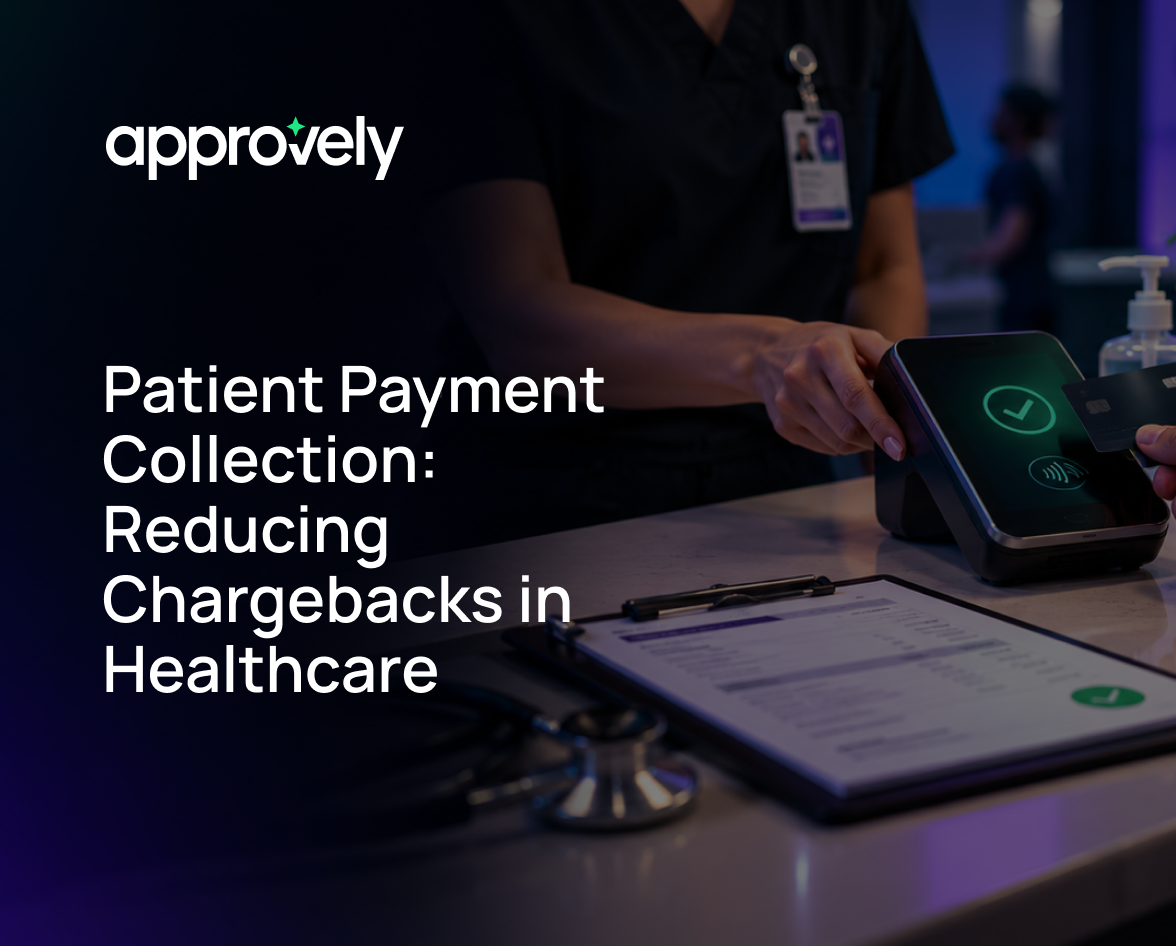
Most healthcare chargebacks start with a confused patient. Here is how practices, clinics, and health systems can collect what they are owed, stay under the card networks' new dispute limits, and defend disputes without exposing protected health information.
Patients now carry a larger share of what healthcare costs, and they pay much of it by card, often weeks after the visit, against a statement they find hard to read. That gap between the care and the bill is where chargebacks come from. A patient who does not recognize a charge, expected insurance to cover it, or was quoted a lower number calls the bank instead of the billing office.
Each of those disputes costs the practice the payment, a fee, and staff time, and since April 2026 it also moves the practice closer to Visa's lower monitoring threshold.
This guide explains why healthcare disputes behave differently from retail ones, which card network rules now apply, and how to build a patient payment collection process that prevents most disputes and wins the rest.
Why Healthcare Chargebacks Look Different
In ecommerce, a dispute usually follows a missing package or a stolen card. In healthcare, the service was almost always delivered, and the patient was almost always the one who paid. The dispute happens because the patient's understanding of what they owe differs from the practice's ledger.
Three features of medical billing drive that gap.
First, the price is often unknown at the time of care, because it depends on coding and on how the insurer adjudicates the claim. Second, the bill often arrives long after the visit, so the charge on the card statement is disconnected from the memory of the appointment. Third, the patient is dealing with two counterparties, the provider and the insurer, and frequently assumes the insurer has already paid.
In KFF's Health Care Debt Survey, 68% of adults with health care debt said they had left a medical bill unpaid or partly paid because they expected their insurance to pay it, and 44% said they had not paid in full because they were not sure the bill was accurate.
The result is that most healthcare disputes are first-party misuse or simple confusion rather than third-party fraud. That distinction matters, because confusion can be prevented with process changes, and first-party misuse can be defeated with the right evidence. Neither is solved by fraud tools alone. For a broader look at dispute mechanics across industries, see our comprehensive guide to reducing chargebacks for high-risk merchants.
The numbers behind patient payment disputes
41% of U.S. adults carry debt from medical or dental bills, and 17% have medical bills on a credit card they are paying off over time (KFF Health Care Debt Survey, June 2022).
About half of adults say they could not pay an unexpected $500 medical bill without borrowing or could not pay it at all (KFF, June 2022).
78% of patients would consider switching providers after a poor payment experience, and nearly 7 in 10 have had a delayed, lost, or incorrect refund (Onbe Healthcare Payments Pulse Survey, 2026).
1.5% is Visa's Excessive threshold for merchants in the U.S. under the Visa Acquirer Monitoring Program, down from 2.2%, effective April 1, 2026 (Visa VAMP updates, 2025 to 2026).
$400 is the amount by which a self-pay patient's bill must exceed the Good Faith Estimate before the patient can start federal patient-provider dispute resolution (CMS, No Surprises Act guidance, 2022).
Where Patient Chargebacks Come From
Practices that track their disputes by cause usually find the same handful of triggers. The table below maps each one to what the patient believes, the dispute category the issuer is likely to use, and the process change that removes it.
Reason code names follow Visa's dispute conditions and Mastercard's Chargeback Guide. The issuer chooses the code, so the same trigger can arrive under a different one.
The Dispute Limits Healthcare Merchants Now Work Under
Healthcare practices have historically sat comfortably below card network limits because most of their revenue comes from insurers rather than cards. That cushion is thinner now. Patient responsibility has grown, more of it is collected online and through card-on-file plans, and Visa has consolidated and tightened its monitoring.
The Visa Acquirer Monitoring Program replaced Visa's separate fraud and dispute programs with one ratio that adds reported fraud and disputes together and divides them by settled transactions. Because a single confused patient can generate both a fraud report and a dispute, the VAMP ratio often reads higher than a practice's old chargeback rate. We covered the enforcement timeline in detail in VAMP is fully enforced: what regulated merchants need to know.
A Patient Payment Collection Process That Prevents Disputes
The most effective chargeback prevention in healthcare happens before the card is charged. Each step below removes one of the triggers in the table above.
1. Give an Estimate Before The Service
Patients dispute bills that surprise them. For uninsured and self-pay patients, an estimate is a legal requirement: under the No Surprises Act, providers must give a Good Faith Estimate within set timeframes after scheduling or on request. Insured patients benefit from the same practice. A written estimate that the patient acknowledged is also strong evidence if the final balance is later disputed as "not as described."
2. Collect At The Point of Service, With a Signed Financial Policy
Payments taken at check-in or check-out are tied to a visit the patient clearly remembers, and card-present chip transactions carry far lower fraud dispute risk than charges keyed in weeks later. Pair this with a short financial policy covering copays, balance billing, no-show fees and refunds, signed or electronically accepted at intake. That signature answers most "services not provided" and "not authorized" claims.
3. Make the Billing Descriptor Recognizable
A descriptor that shows a billing company, a parent entity or an abbreviation the patient has never seen is the single most common source of avoidable fraud claims. Use the name on the practice's door and a billing phone number. Visa also recommends keeping descriptors consistent across transactions, which matters later for compelling evidence matching.
4. Offer Payment Plans and Card-on-File With Explicit Consent
Payment plans reduce bad debt, but every stored-card charge is a potential "I didn't authorize this" dispute. Record the patient's consent to the schedule and amounts, send a reminder before each installment, and send a receipt after it. Patients clearly want these options: 87% of consumers said it is important for their provider to offer their preferred payment method in an American Express and Forbes Insights survey.
5. Authenticate Online and Portal Payments
Patient portals and text-to-pay links are card-not-present transactions, which is where fraud disputes count most heavily toward VAMP. EMV 3-D Secure lets the issuer authenticate the cardholder, usually without extra steps, and authenticated transactions generally shift fraud liability to the issuer. Applied selectively to higher-value balances, it protects revenue without hurting approval rates. Our deep dive into authorization rates explains how to balance the two.
6. Send Itemized Statements and Refund Quickly
Statements should show the date of service, the provider, what insurance paid and what the patient owes, in plain language. Credit balances from overpayments or late insurance payments should go back to the original card on a fixed schedule. A patient who is waiting on a refund will often ask the bank for it instead.
7. Resolve Disputes Before They Become Chargebacks
Pre-dispute tools let the issuer see transaction details, or let the merchant refund, before a formal chargeback is filed. Visa's Compelling Evidence 3.0 rule is especially useful for practices with returning patients.
If the disputed card has two earlier undisputed payments made 120 to 365 days before the dispute, and at least two data points match (for example IP address or device ID plus patient account login), the fraud claim can be blocked and liability moves to the issuer. Practices with chronic-care and follow-up patients often meet these criteria without changing anything except what data they capture.
Fighting Healthcare Chargebacks Without Breaking HIPAA
Many practices accept disputes they could win because they believe HIPAA prevents them from sending evidence. It does not. HHS guidance on uses and disclosures for treatment, payment and health care operations lists billing and collection among permitted payment activities.
The condition is the minimum necessary standard: disclose only what the dispute requires. In practice, that means proving the visit happened and the patient agreed to pay, not explaining the diagnosis.
Behavioral health, substance use treatment and reproductive care carry extra sensitivity and, in some cases, additional federal or state rules. For those services, have your compliance lead approve a standard evidence template before disputes arrive.
Why Your Processor Matters for Patient Payments
Many healthcare merchants, particularly elective care, aesthetics, telehealth, dental specialties, and cash-pay clinics, are underwritten as higher risk because of ticket size and dispute history. General-purpose processors often respond to a dispute spike by holding funds or closing the account, which interrupts collections at the worst moment. If that has happened to you, our comparison of alternatives to Stripe for high-risk merchants covers what to look for.
Approvely is built for this kind of merchant. Practices are onboarded the same day and typically go live in 3 to 5 business days. Across our portfolio we maintain a 96.43% card acceptance rate and a 98.05% chargeback protection rate, and support is US-based. Approvely brings payment acceptance, dispute alerts, and monitoring into one platform, so billing teams can see their ratios before the card networks do.
Healthcare Chargebacks: Frequently Asked Questions
1. What causes most healthcare chargebacks?
Billing confusion. Patients dispute charges they do not recognize, balances they expected insurance to cover, and amounts higher than they were quoted. True third-party card fraud is a smaller share for most practices.
2. Can a medical practice share patient information to fight a chargeback?
Yes. HIPAA permits disclosures for payment activities, including billing and collection, as long as the practice limits what it shares to the minimum necessary. Prove the service and the agreement to pay, and leave out clinical details.
3. Does Visa's VAMP apply to healthcare providers?
VAMP applies to every merchant that accepts Visa, regardless of industry. A practice that exceeds the merchant threshold and the monthly volume floor can face enforcement fees, and its acquirer may act sooner.
4. How do patient payment plans affect chargeback risk?
They lower bad debt but add stored-card charges that patients may later dispute. Recorded consent, reminders before each installment, and receipts afterward keep those disputes rare and winnable.
5. What is the fastest way to reduce healthcare chargebacks?
Fix the billing descriptor, post point-of-service payments before statements go out, and turn on pre-dispute alerts. Those three changes address the triggers behind most avoidable disputes.
Share this post