BLOG
>
Blog
How Intelligent Routing Improves Authorization Rates
What smart routing decides on every transaction, where it recovers approvals, and how regulated businesses can run payment routing optimization without trading away compliance.
Elizabeth Balash
11/25/2026

6
MIN READ
How Intelligent Routing Improves Authorization Rates
What smart routing decides on every transaction, where it recovers approvals, and how regulated businesses can run payment routing optimization without trading away compliance.
Most payment teams look at authorization rate as a single number on a dashboard. Underneath it sits thousands of separate decisions: which acquirer received each transaction, what data went with it, and what happened after a soft decline. When those decisions are fixed in static rules, a share of good customers gets turned away for reasons that have nothing to do with fraud or funds.
Intelligent payment routing makes those decisions per transaction, using live performance data, and for businesses in regulated and specialized industries, it is one of the few levers that lifts approvals without lowering risk standards.
What Intelligent Payment Routing Decides on Every Transaction
A static setup sends traffic by rule: all EU cards to one acquirer, everything else to another, and a second processor kept for outages. Those rules were usually written once, at integration, and reflect what performed well at that time.
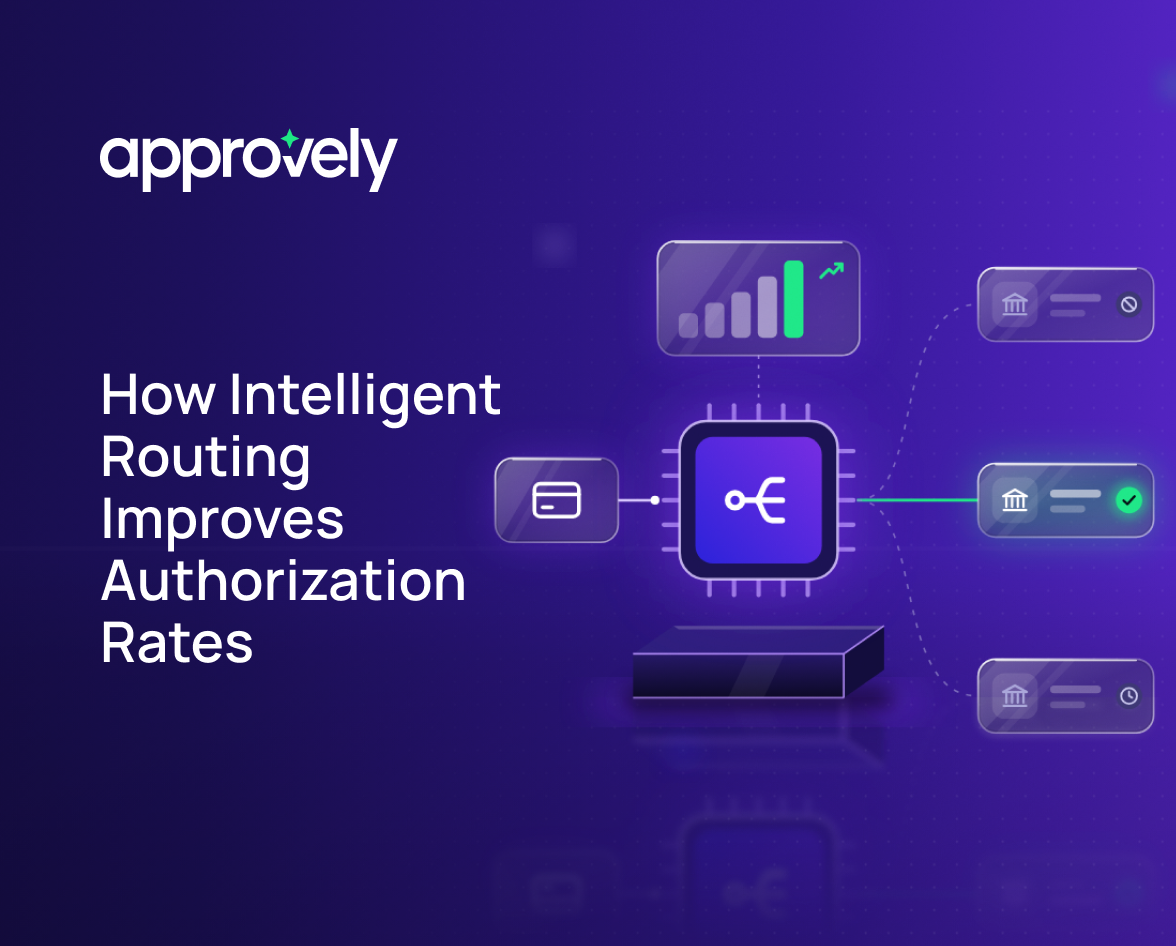
Intelligent payment routing replaces the fixed rule with a decision made at the moment of authorization. The router looks at the card (BIN, issuing country, card type, network), the transaction (amount, currency, recurring or one-time, card-present or not) and the current state of each available connection (recent approval rates, latency, error rates, cost). It then sends the payment where it has the best chance of approval at an acceptable cost, and decides what to do if the first attempt fails.
Where Authorization Rates Leak Before Routing Gets Involved
A decline is not always a judgment about the customer. Issuers decline because the acquirer's traffic profile looks unfamiliar, because the transaction is cross-border, because the stored card number has been reissued, or because a connection timed out. Each of these is a routing or data problem, and each looks identical to fraud on a top-line report.
The cost of declining good customers
Javelin Strategy & Research estimated that false declines cost US merchants $118 billion in lost sales, against $9 billion in actual card fraud (Javelin, via Digital Transactions).
Visa's 2026 Global eCommerce Payments & Fraud Report found that payment success rate and revenue are now the top two KPIs merchants track, and that false positives kept rising even as overall fraud fell (Visa Acceptance Solutions, 2026).
Visa reports a 4.3% increase in authorization rates for card-not-present transactions using network tokens compared with raw card numbers (Visa, 2026).
The arithmetic is simple. A business processing $100 million a year at an 85% authorization rate that moves to 88% recovers about $3.5 million in approved volume, with no extra acquisition spend. For a deeper look at how issuers score transactions, see our guide on what drives authorization rates and how to improve payment success.
How Smart Routing Authorization Recovers Approvals
Smart routing authorization works through a handful of mechanisms. The size of the uplift depends on how many of them run together and how much transaction history the router has to learn from. Vendor-reported results vary widely: Primer reported pilot merchants seeing authorization uplift of up to 5%, and an 8% average uplift across merchants on its smart routing. Treat any single figure as a range, not a promise; your baseline, card mix and markets decide the outcome.
1. Matching issuers to the acquirers they approve
Issuers approve more readily when the acquirer is local to them and has a clean history with their cardholders. A UK-issued card sent through a US acquirer is processed as cross-border and scored more cautiously. Routing by BIN and issuer country to the acquirer with the strongest recent approval rate for that issuer is usually the largest single source of uplift for businesses selling across borders.
2. Failing over before customers notice
Acquirers and gateways have partial outages: higher timeouts, slower responses, error spikes on one card type. A router that watches these signals in real time can move traffic within seconds, instead of after a payments lead spots a dip in the next morning's report. Every transaction that times out during checkout is a lost sale that never appears as a decline.
3. Cascading soft declines within network rules
When a transaction comes back with a soft decline (do not honor, issuer unavailable, a timeout), resending it through a second acquirer can turn it into an approval. This only works if the router reads the decline code properly. Visa groups decline codes into four categories, and under its excessive reattempts rule category 1 declines may not be retried, and soft declines are capped at 15 reattempts in 30 days, with per-transaction fees beyond that. Mastercard sends merchant advice codes that tell you whether and when to try again. A routing engine that ignores these signals adds network fees and makes issuers more suspicious of your traffic.
4. Sending the data issuers use to approve
Routing is also about what travels with the payment. Network tokens update automatically when a card is reissued, which keeps recurring billing from failing on stale credentials. Complete 3-D Secure data gives issuers more to score, and incomplete or placeholder values tend to produce more challenges.
A good router knows which acquirers support tokens and authentication data for which networks and markets, and routes accordingly. This matters most for subscription models; our post on involuntary churn and chargebacks in video game subscriptions covers the recurring side in detail.
5. Weighing cost against approval odds
When two routes approve at the same rate, the cheaper one should win. When one approves noticeably better, a slightly higher fee is usually worth paying. Payment routing optimization means scoring both on every transaction rather than optimizing one and ignoring the other. Debit routing, interchange qualification and acquirer pricing all feed into that score.
Not sure where your approvals are leaking?
Approvely can review your decline codes, acquirer mix and retry logic, and show where routing, tokens or authentication data would change the outcome.
Payment Routing Optimization in Regulated Industries
For gaming, iGaming, crypto, nutraceuticals, marketplaces and other specialized verticals, routing has constraints that general-purpose guides leave out. Not every acquirer is underwritten for every merchant category code or market, so the set of eligible routes is smaller and has to be maintained with compliance in view. Moving volume between acquirers also moves dispute ratios, and under Visa's acquirer monitoring program, a spike on one connection can put that relationship at risk. Our breakdown of what full VAMP enforcement means for regulated merchants explains the thresholds.
This is why routing works best as part of the same infrastructure that handles fraud screening, chargeback prevention and settlement. A route that approves more transactions but also lets through more friendly fraud is not an improvement. A route that approves well but settles slowly ties up working capital. Regulated businesses get the most from routing when approval data, dispute data and settlement timing sit in one view, so a routing change can be judged on all three. For dispute-side tactics, see our comprehensive guide to reducing chargebacks; for multi-party flows, our post on marketplace split payments, escrow and compliance covers the extra routing considerations.
Measuring What Routing Actually Changes
Authorization rate alone can mislead. A router that retries aggressively can raise the reported rate while adding network fees, and a cheaper route can lift margin while lowering approvals on one card type. Track the following together, broken out by acquirer, card network, issuing country and transaction type.
Intelligent Payment Routing: Frequently Asked Questions
1. What is intelligent payment routing?
Intelligent payment routing is the practice of choosing, for each transaction, which acquirer or processor should handle it, based on live data about approval rates, cost and connection health. It replaces fixed rules (such as sending all traffic from one region to one acquirer) with a decision made at the moment of authorization.
2. How much can smart routing improve authorization rates?
It depends on your starting point. Businesses with a single acquirer, heavy cross-border volume or no decline-code handling tend to see the largest gains; vendor-reported averages range from low single digits to around 8 percentage points. Businesses that already route by issuer country and use network tokens should expect smaller, though still meaningful, improvements.
3. Is cascading a declined payment to another acquirer allowed?
Yes, for soft declines, within card network limits. Hard declines such as stolen card or closed account should never be retried, and Visa caps soft-decline reattempts within a 30-day window. A compliant routing setup reads the decline code before deciding whether to cascade.
4. Does payment routing optimization affect chargebacks?
It can. Shifting volume changes each acquirer's dispute ratio, and approving more borderline transactions can raise fraud disputes if risk screening does not keep pace. That is why routing decisions should be reviewed alongside chargeback and fraud data, not in isolation.
5. Does Approvely support routing for regulated businesses?
Approvely provides payment infrastructure for regulated and specialized industries, with acquiring, fraud monitoring, chargeback protection and settlements connected in one platform. Merchants on Approvely see a 96.43% card acceptance rate, with onboarding on the same day and go-live in 3 to 5 business days. Learn more about our scalable payment platform.
Higher approvals, with risk and compliance built in
Approvely connects payments, fraud prevention, chargeback protection and settlements for regulated businesses: a 96.43% card acceptance rate, a 98.05% chargeback protection rate, same-day onboarding, go-live in 3 to 5 business days, and US-based support.
Share this post


Blog