BLOG
>
Blog
Crypto Deposits for iGaming: Stablecoins, Wallets & Regulation
Stablecoins now carry most of the money that crypto players send to casinos and sportsbooks. Here is how the rails, the wallets, and the 2026 rulebooks fit together, and what an operator needs in place before a crypto cashier goes live.
Elizabeth Balash
11/23/2026

6
MIN READ
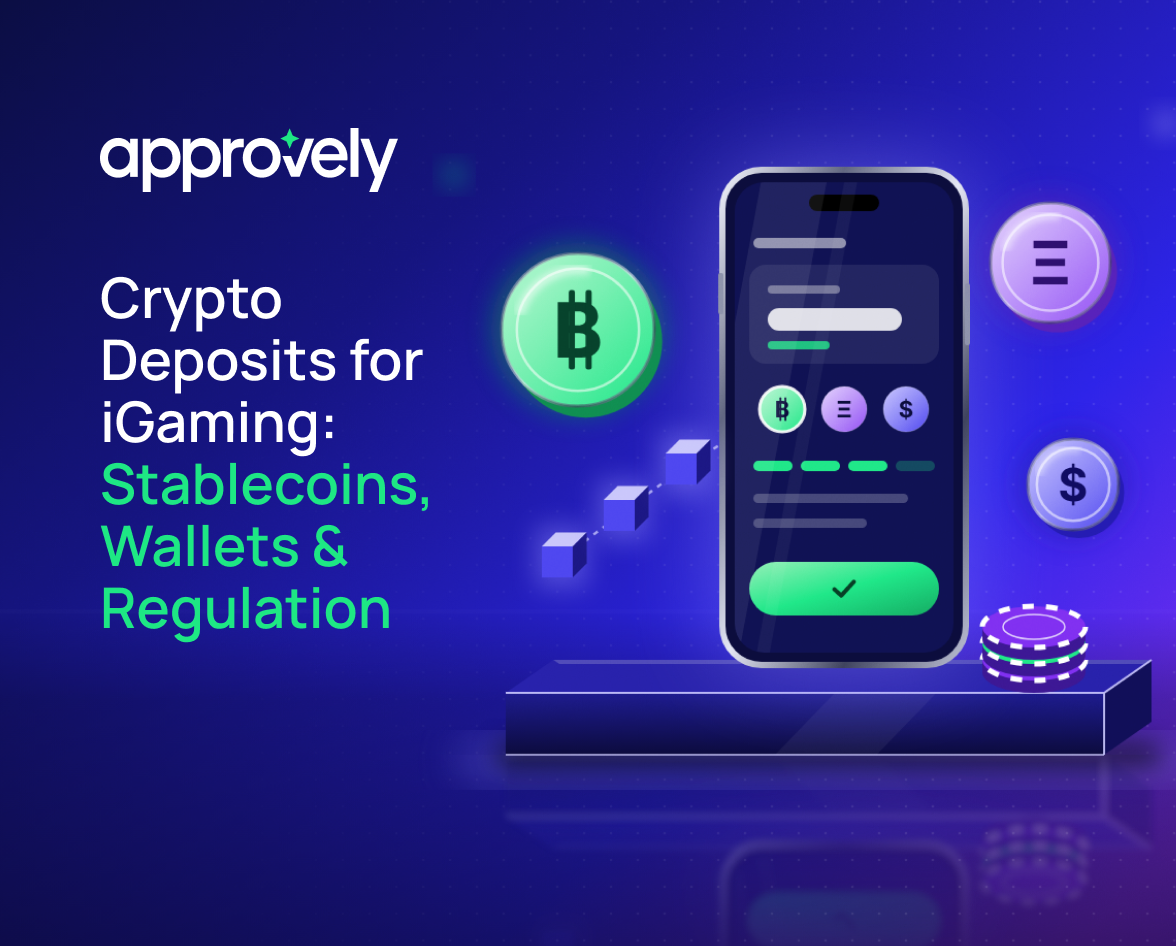
Crypto Deposits for iGaming: Stablecoins, Wallets & Regulation
Stablecoins now carry most of the money that crypto players send to casinos and sportsbooks. Here is how the rails, the wallets, and the 2026 rulebooks fit together, and what an operator needs in place before a crypto cashier goes live.
Two years ago, a conversation about crypto iGaming deposits was mostly a conversation about Bitcoin. In 2026 it is mostly a conversation about digital dollars. Players still choose crypto for speed and reach, but the asset they send is now usually a stablecoin, and the questions operators face have moved with it: which tokens a regulator will accept, how to know who controls the sending wallet, and how to settle, reconcile and report funds that arrive on a blockchain instead of a card network.
This guide covers the rails, the wallet controls and the regulatory picture across the EU, the US, the UK, Curaçao and Malta.
Crypto iGaming Deposits in 2026: Stablecoins Now Lead
The data from several independent trackers points the same way. A stablecoin report from iGaming Business and RYKI, built on six weeks of on-chain deposit data from March and April 2026, found that dollar-pegged stablecoins fund about three-quarters of crypto casino deposits. The same report notes that bank withdrawals take one to five business days, compared with under ten minutes for crypto, and that operators report payment cost reductions of 60% to 70%.
Volume has held up even through a weaker crypto market. TRM Labs measured USD 14 billion in on-chain gambling volume in Q1 2026, close to the Q4 2025 record of USD 15 billion, after a full-year 2025 total of USD 51 billion. TRM attributes the resilience to repeat users and stablecoin flows rather than speculation.
By the numbers: crypto gambling payments in 2026
75.5% of August 2026 deposit volume across 41 tracked crypto casinos came in USDT, USDC or DAI, while those stablecoins made up only 55.1% of the reserves the casinos held (VIP-Grinders Crypto Casino Market Report, August 2026).
USD 14 billion in on-chain gambling volume in Q1 2026, and USD 51 billion across 2025 (TRM Labs, June 2026).
2 million+ personal wallets interacted with gambling platforms between January 2022 and March 2026 (TRM Labs, June 2026).
32% higher average player lifetime value at stablecoin-first casinos than at brands running on volatile tokens in Q1 2026, per SOFTSWISS data cited by iGaming Business, 2026.
The gap between deposits and reserves matters for treasury teams. Players deposit in stablecoins, but operators still hold native tokens for network fees on withdrawals, and some move stablecoins to cold storage quickly. Every operator taking crypto is running a small foreign-exchange and liquidity book, whether or not it planned to.
Stablecoin Gambling Payments vs. Bitcoin Sports Betting Payments: How the Rails Compare
Each rail has a different profile for speed, cost, price risk and regulatory standing. The table below compares the options operators most often support alongside cards.
1. Why stablecoin gambling payments took over
A stablecoin deposit is worth the same when the player places a bet as when they withdraw, so neither side carries price risk between deposit and settlement. Fees on networks such as Tron are usually well under a dollar, which makes small reloads practical.
TRM Labs reports that USDT makes up about 94% of gambling flows on Tron, and that stablecoins account for roughly 70% of all on-chain gambling volume since 2022. For operators, a dollar-denominated balance also makes bonus accounting, responsible gambling limits and reporting much simpler than a balance that moves with the BTC price.
2. Where bitcoin sports betting payments still fit
Bitcoin remains the asset many bettors think of first, and it still accounts for a meaningful share of larger, less frequent deposits. The constraint for sportsbooks is timing. An on-chain BTC deposit that waits for one to six confirmations can miss an in-play market.
The Lightning Network removes most of that delay, with settlement in seconds and fees usually under a cent, which is why a growing group of sportsbooks now support it for both deposits and withdrawals. If you offer BTC, decide in advance how many confirmations you require, how you price the deposit into a fiat-denominated account, and whether withdrawals go out in BTC or in the account currency.
Wallets: Knowing Who Is Behind the Address
A card payment arrives with an issuing bank, a name check and a scheme behind it. A crypto deposit arrives from an address. The core compliance task is connecting that address to a verified player and to a lawful source of funds, and the method depends on the type of wallet.
- Hosted wallets (an exchange or custodial app) sit with a virtual asset service provider (VASP) that has already run KYC. Under the FATF Travel Rule, the sending VASP should pass originator details with the transfer. FATF's July 2026 update found that 83% of surveyed jurisdictions now have Travel Rule legislation, up from 73% in 2025, though many have yet to supervise or enforce it.
- Self-hosted wallets have no intermediary. Operators typically ask the player to prove control of the address (a signed message or a small test transaction) and screen the address history with blockchain analytics before crediting.
- Operator wallets need the same discipline: one deposit address per player, segregation of player funds from operating funds, clear hot and cold wallet limits, and a documented process for addresses flagged after the fact.
Address screening is not optional. TRM Labs identifies three patterns of illicit activity around crypto gambling: platforms used as laundering infrastructure, platforms that are themselves frauds, and platforms targeted by attackers. A deposit from a sanctioned or mixer-linked address is a licensing problem as well as an AML one, so the screening result needs to be logged alongside the player record. Our compliance infrastructure for regulated operators is built around exactly that kind of auditable record.
Adding crypto to your cashier, or keeping it behind the scenes?
Some operators want stablecoins at the cashier. Others want faster cross-border settlement without changing the player experience at all. Approvely supports both with compliance, risk and liquidity connected in one platform.
The 2026 Regulatory Map for Crypto iGaming Deposits
Two sets of rules apply at once: gambling law, which decides whether a licensee may accept crypto at all, and financial regulation, which decides which tokens and service providers are allowed in a market. The table summarises where the main jurisdictions stand as of November 2026.
1. EU: MiCA decides which stablecoins your partners can touch
MiCA does not regulate gambling, but it shapes the payment chain around it. Since 1 July 2026, any firm providing crypto-asset services to EU clients needs full CASP authorisation, and the national grandfathering windows have closed. Tether has not sought MiCA authorisation for USDT, so EU-regulated exchanges have removed it, while Circle's USDC and EURC are issued under the e-money token framework.
For an operator serving EU players, this means the exchange, custody and conversion partners in your flow should be authorised CASPs, and a USDT-only cashier is hard to defend to an EU regulator or bank.
2. United States: federal stablecoin rules, state gaming rules
The GENIUS Act, signed in July 2025, creates the first federal framework for payment stablecoin issuers, with 1:1 reserves and full Bank Secrecy Act coverage. The OCC issued its final implementing rule on 21 October 2026, and the law takes effect on 18 January 2027. That makes regulated dollar stablecoins easier for banks and payment firms to support, but it does not authorise gambling payments.
Whether a sportsbook may accept crypto is still a question of state law. Wyoming's HB 133 expressly lets operators accept digital and virtual currencies to fund accounts, which remains unusual among US betting states. Teams already working through state-by-state card acceptance, such as the challenges in our fantasy sports merchant account guide, should expect crypto to follow the same pattern.
3. Great Britain: a cautious opening
GB-licensed operators do not currently have an established route to accept crypto deposits at scale. In February 2026, the Gambling Commission asked its Industry Forum to explore what a sensible pathway could look like, describing it as a tentative first step with no timetable, as Bird & Bird summarised. Any future route is likely to sit alongside the FCA's incoming cryptoasset regime and to require the same evidence on source of funds that applies to card and bank deposits.
4. Curaçao: crypto allowed, controls now written down
Curaçao has long been the main licence for crypto-first casinos. In June 2026 the Curaçao Gaming Authority published its first crypto policy guideline for online gaming operators. It covers deposits, wagering, withdrawals and treasury, requires blockchain analytics and wallet segregation, bans mixers, and limits licensees to accepting crypto for gambling services only rather than acting as an exchange. Some prohibitions applied immediately, with phased compliance running to June 2027.
5. Malta: approval first, then reporting discipline
Under the MGA's policy on distributed ledger technology, licensees need prior approval before accepting DLT assets and must classify each asset they plan to support. The policy also fixes the exchange rate for reporting at midnight CET on the last day of the reporting month, which removes one source of reconciliation disputes.
No Chargebacks Does Not Mean No Risk
Crypto deposits are push payments, so there is no cardholder dispute right and no chargeback ratio to manage. For operators who have dealt with card scheme monitoring, explained in our guide to VAMP enforcement, that is a real advantage. The risk moves elsewhere:
- Tainted funds. A deposit that later proves to come from fraud or a sanctioned source can lead to frozen funds, an issuer blacklist or regulatory findings. Screening before credit is the control.
- Price and FX exposure. Volatile assets held between deposit and conversion, and stablecoins settled against EUR or GBP liabilities, both create exposure. The same multi-currency discipline we describe in our multi-currency processing article applies here.
- Bonus abuse and multi-accounting. New addresses are free to create, so device, identity and behavioural signals matter more than they do for cards. Fraud prevention tooling should cover crypto accounts as well as card accounts.
- Card disputes on mixed accounts. Players who fund with both card and crypto can still dispute the card leg. Keep the dispute controls from our chargeback reduction guide in place for every fiat rail.
How Approvely Supports Crypto in Regulated Gaming
Approvely connects payments, compliance, risk, and liquidity for regulated operators, including iGaming and sportsbook businesses and crypto companies. Our crypto infrastructure uses stablecoin rails at the settlement layer to shorten cross-border settlement and reduce reliance on a single banking path, while players keep a familiar card and bank checkout. Every crypto component runs with the monitoring and audit trail a regulated business needs. Operators also get a 96.43% card acceptance rate, a 98.05% chargeback protection rate, same-day onboarding, go-live in 3 to 5 business days, and US-based support.
Crypto iGaming Deposits: Frequently Asked Questions
1. What are crypto iGaming deposits?
They are player deposits to an online casino, sportsbook or other gaming platform made in a cryptoasset, usually a stablecoin such as USDT or USDC, or Bitcoin. Funds move on a blockchain rather than a card network, and the operator credits the player's account once the transaction is confirmed and screened.
2. Why are stablecoin gambling payments overtaking Bitcoin?
Stablecoins hold a steady dollar value, settle quickly and cost little on networks like Tron, so neither the player nor the operator carries price risk between deposit and withdrawal. Trackers now put stablecoins at roughly three-quarters of crypto casino deposit volume.
3. Are bitcoin sports betting payments legal?
It depends on the licence. Curaçao and Malta permit crypto under defined controls, Wyoming allows crypto account funding for sportsbooks, and GB-licensed operators have no established route yet. Check each licence and market you serve before enabling BTC at the cashier. This article is general information, not legal advice.
4. Can players file a chargeback on a crypto deposit?
No. On-chain transfers are final, so there is no chargeback mechanism. Operators still face risks from tainted funds, issuer freezes, bonus abuse and card disputes on accounts that also use fiat.
5. Does MiCA ban USDT for gambling operators?
MiCA does not regulate gambling directly, and it does not ban holding or transferring USDT. It does stop authorised EU crypto-asset service providers from offering it, because USDT is not MiCA-authorised. In practice, operators serving EU players usually standardise on MiCA-compliant tokens such as USDC and EURC.
6. Does Approvely support crypto for iGaming operators?
Yes. Approvely provides stablecoin-based settlement infrastructure alongside card, bank, and payout rails, with compliance and risk controls connected in one platform. Talk to our team to map the right setup for your licences and markets.
Crypto and fiat rails for regulated gaming, in one platform
Faster settlement, connected compliance and real visibility across every rail. 96.43% card acceptance, 98.05% chargeback protection, and go-live in 3 to 5 business days.
Share this post


Blog