BLOG
>
What Is a Chargeback? How They Work & Why High-Risk Merchants Are Vulnerable
Chargebacks can hit long after a sale is complete, and for high-risk merchants, the impact can be significant.
8/25/2026
.svg)
6
MIN READ
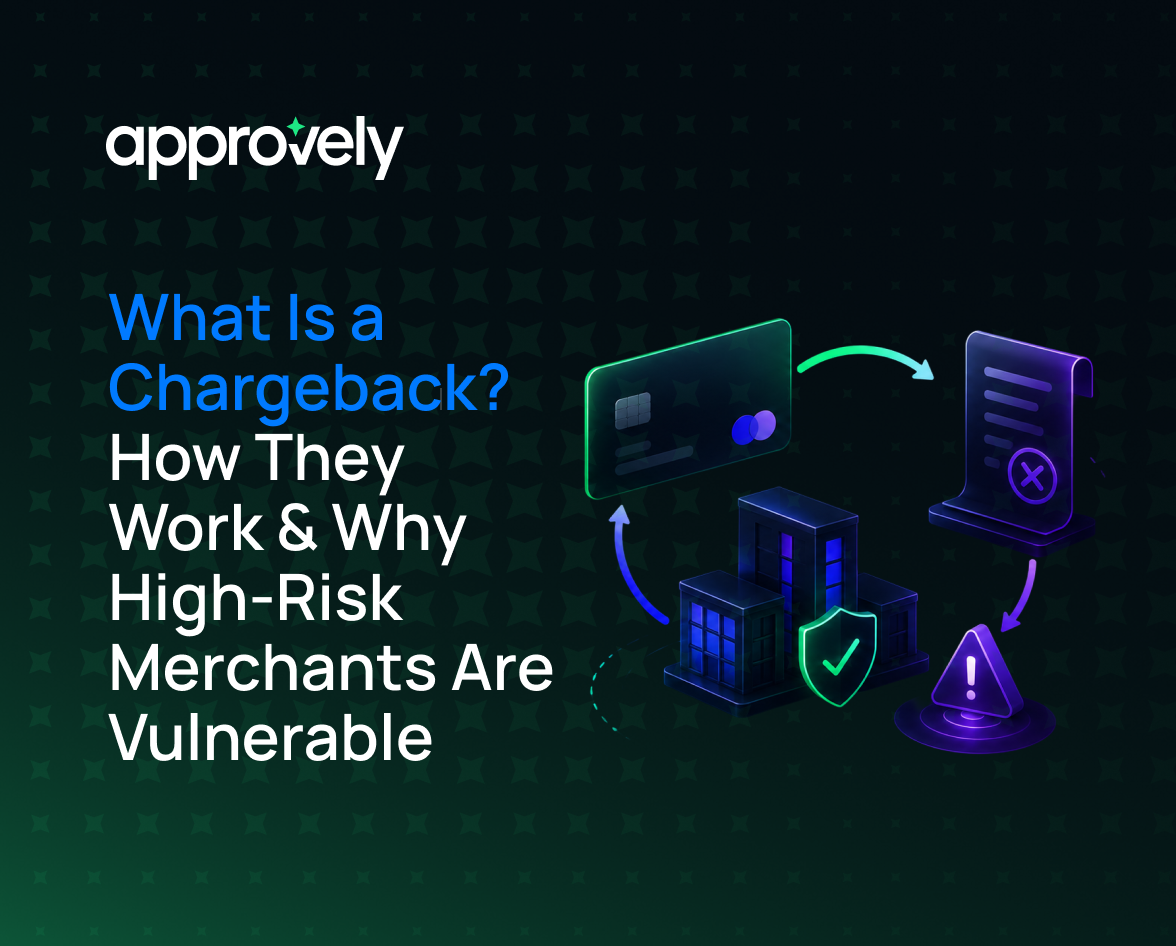
A chargeback is one of the few payment events that can take money out of a merchant's account weeks or months after the sale already closed. For most retailers, that's an occasional headache. For high-risk merchants like iGaming, sweepstakes, telehealth, and a handful of other regulated verticals, it's closer to an existential risk, since a single bad quarter of disputes can trigger card network monitoring programs, higher reserves, or the loss of a processing relationship entirely.
This guide covers what a chargeback actually is, how the dispute process works from the first phone call to final resolution, and why high-risk merchants end up carrying so much more of this exposure than everyone else.
What Is a Chargeback?
A chargeback is a forced reversal of a card payment, initiated by the cardholder's bank (the issuer) rather than the merchant. It exists as a consumer protection mechanism: if a cardholder doesn't recognize a charge, never received what they paid for, or believes they were billed incorrectly, they can ask their bank to pull the funds back from the merchant instead of chasing a refund directly.
That protection is grounded in federal law. In the US, credit card disputes are governed by the Fair Credit Billing Act, which requires card issuers to investigate billing complaints and gives cardholders a formal path to dispute charges without immediately paying for them. Debit card disputes fall under a related law, the Electronic Fund Transfer Act. Visa and Mastercard build their own network-level chargeback rules on top of that legal floor, which is why the process looks similar across card brands but differs in timelines and evidence requirements.
Chargeback vs. Refund
A refund is something the merchant initiates and controls — the customer asks, the merchant agrees, and the money moves back voluntarily. A chargeback is something the merchant has no say in until after the fact: the bank pulls the funds first and only then gives the merchant a chance to contest it. That distinction matters because a chargeback also carries a separate fee, charged by the acquiring bank regardless of the outcome, on top of the disputed transaction amount itself.
How the Chargeback Process Actually Works
The mechanics are broadly consistent across Visa, Mastercard, and other networks, even though each publishes its own version of the rules. Visa's own explanation of the process breaks it down into a few core stages:
- The cardholder disputes a charge. They contact their issuing bank — not the merchant — to report a transaction they don't recognize, didn't authorize, or believe was billed incorrectly.
- The issuer reviews the claim. If it looks credible, the issuer often issues a provisional credit to the cardholder while the investigation continues.
- The merchant is notified. The acquiring bank passes the dispute to the merchant, typically with a reason code explaining why the transaction was flagged.
- The merchant can respond (representment). This is the merchant's one real chance to fight back — submitting evidence such as delivery confirmation, IP and device data, or proof of terms accepted at checkout to show the transaction was legitimate.
- The network issues a final decision. If the merchant's evidence holds up, the charge is reinstated. If not, the reversal becomes permanent, and the merchant absorbs the loss, the chargeback fee, and a mark against its dispute ratio.
Cardholders generally have up to 120 days to file a dispute, while merchants are often given only a few weeks to respond with evidence, an asymmetry that puts most of the operational burden on the business side of the transaction, not the consumer side.
Common Reasons Chargebacks Happen
Card networks assign a reason code to every dispute, but they generally fall into a few buckets:
- Fraud. The card was stolen, or the credentials were compromised, and the actual cardholder never made the purchase.
- Item or service not received. The cardholder paid but claims they never got what they were promised.
- Not as described. The product, service, or terms didn't match what was represented at checkout.
- Processing errors. Duplicate charges, incorrect amounts, or a merchant billing after a subscription was cancelled.
- Friendly fraud. The transaction was legitimate, and the cardholder actually made it, but they dispute it anyway, sometimes out of confusion, sometimes deliberately, to get a refund while keeping the product or service.
That last category has become the dominant driver of dispute volume. Industry research consistently finds that a large majority of chargebacks now originate from friendly fraud rather than genuine unauthorized use, and multiple 2026 industry reports show the large majority of enterprise merchants seeing this problem grow year over year. Because friendly fraud looks identical to a legitimate transaction on paper, it's also the hardest type of chargeback to prevent with fraud-screening tools alone.
Why High-Risk Merchants Are Especially Vulnerable
Elevated Scrutiny by Design
Card networks assign every merchant a Merchant Category Code, and certain codes - gambling, subscription and continuity billing, travel, telehealth, nutraceuticals, adult content are treated as inherently higher-dispute categories. That classification alone means issuers apply tighter fraud screening and are more willing to side with the cardholder when a dispute is close to a judgment call.
Business Models That Invite Disputes
Several features common to high-risk verticals map directly onto the most common chargeback reason codes. Subscription billing creates "I forgot to cancel" disputes. Delayed or intangible delivery (travel bookings, digital services, pharma) creates "item not received" disputes. Regulated products with strict eligibility rules (firearms, telehealth) create "not as described" disputes when a customer's expectations don't match what compliance actually allows the merchant to deliver.
Card Network Monitoring Programs Raise the Stakes
Because high-risk verticals run closer to network dispute thresholds by default, they have far less room for error when a monitoring program tightens. Visa's Acquirer Monitoring Program (VAMP) consolidates fraud reports and chargebacks into a single ratio and applies escalating fees and account-level consequences once a merchant crosses the threshold. Visa lowered that merchant threshold from 2.2% to 1.5% in April 2026, with a flat per-transaction fee applied to merchants who land in the program, a tightening that disproportionately affects high-risk verticals whose baseline dispute rates already sit closer to the line than mainstream retail.
The Downstream Consequences Compound
A high chargeback ratio doesn't just cost the fee on each individual dispute. It can trigger rolling reserves, higher processing rates, mandatory compliance programs, and in the worst cases, account termination and placement on a terminated-merchant file that makes it far harder to get approved by another acquirer. For a high-risk operator, that last outcome isn't a minor inconvenience; it can mean losing the ability to accept card payments at all.
How High-Risk Merchants Can Reduce Chargeback Exposure
None of this is fully avoidable, but it is manageable. The merchants who keep their dispute ratios under control tend to invest in a few specific areas:
- Clear billing descriptors that match the brand name customers recognize, which is one of the most common triggers for "I don't recognize this charge" disputes.
- Pre-dispute alerts that flag a transaction before it escalates into a formal chargeback, giving the merchant a chance to refund proactively and avoid the dispute ratio hit entirely.
- Strong identity and fraud screening at checkout to catch genuine third-party fraud before it settles, since prevention is cheaper than any representment process.
- A dedicated chargeback management partner who understands high-risk reason codes and can build the evidence packages that actually win representment cases, rather than treating every dispute as a lost cause.
This is the specific gap Approvely's chargeback protection is built to close, paired with fraud prevention and built-in compliance tooling designed specifically for high-risk verticals. On the current infrastructure, that translates to a 98.05% chargeback protection rate and 97% real-time fraud blocking across the platform, the kind of performance that keeps high-risk merchants well clear of network monitoring thresholds instead of chasing disputes after the fact.
The Bottom Line
Chargebacks aren't going away, and for high-risk merchants they aren't optional to plan for; the business model itself invites more disputes than mainstream retail, and card network rules are only getting stricter about how much dispute activity they'll tolerate. The merchants who treat chargeback management as core infrastructure, not a reactive process, are the ones who keep their processing relationships intact. For operators building or strengthening their payment stack, Approvely's high-risk payment infrastructure combines chargeback protection, fraud prevention, and compliance in one platform, with same-day onboarding and 3–5 business day go-live.
Frequently Asked Questions
What's the difference between a chargeback and a dispute?
The terms are often used interchangeably, but technically "dispute" is the broader process a cardholder initiates with their bank, and "chargeback" is the specific outcome where funds are actually reversed from the merchant. Not every dispute ends in a chargeback, some are resolved with a simple refund or closed once the issuer reviews the claim.
How long does a merchant have to respond to a chargeback?
It varies by card network and dispute stage, but merchants are typically given somewhere between 20 and 30 days to submit evidence once a chargeback is filed, far shorter than the up to 120 days cardholders are often given to file the dispute in the first place.
Can a merchant win a chargeback dispute?
Yes, through a process called representment, where the merchant submits evidence, proof of delivery, signed terms, IP and device data, and prior communication with the customer, to show the transaction was legitimate. Win rates vary significantly by evidence quality and reason code, which is why merchants with dedicated chargeback management tend to recover meaningfully more disputes than those handling representment manually.
Why do high-risk merchants pay higher processing fees because of chargebacks?
Acquiring banks price in the risk of the merchant category they're underwriting. A vertical with a historically elevated dispute rate carries more financial exposure for the acquirer, which shows up as higher per-transaction fees, mandatory rolling reserves, and stricter chargeback ratio limits than a low-risk merchant would face for the same sales volume.
What happens if a merchant's chargeback ratio gets too high?
Once a merchant crosses a card network's monitoring threshold, they can be enrolled in a formal program that adds per-transaction fines on top of existing chargeback fees. If the ratio doesn't improve, the consequences escalate to higher reserves, processing restrictions, or termination of the merchant account, which can also result in the business being placed on a shared terminated-merchant file that makes it harder to get approved elsewhere.
Share this post



.webp)