BLOG
>
How Pay-by-Bank Is Transforming iGaming Deposits
Pay-by-bank is giving iGaming operators another path, moving funds directly from a player’s bank account while reducing reliance on card rails that often flag MCC 7995 transactions.
8/21/2026
.svg)
7
MIN READ
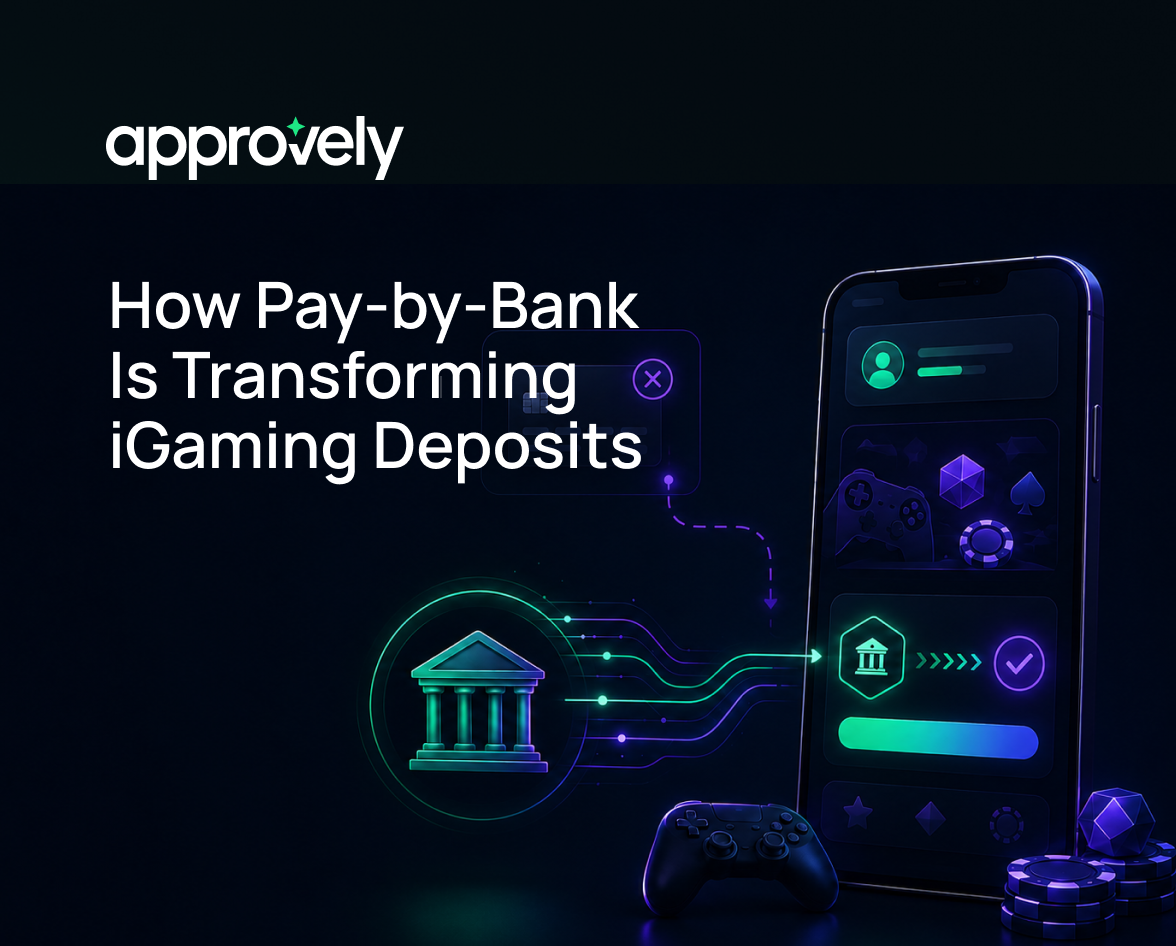
Card declines have quietly become one of the biggest drags on iGaming conversion. Gambling merchants are assigned Merchant Category Code 7995, one of the categories card networks flag for the heaviest scrutiny, and issuers frequently block transactions under that code before they ever check whether the cardholder has the funds to cover them. Every one of those declines is a player who may not come back to try again.
Pay-by-bank: the account-to-account rail built on open banking is closing that gap, and it has moved from a European niche to a default deposit option across regulated markets in only a few years.
This guide breaks down how the technology actually works, why it fits iGaming's payment problem so well, and what operators should know before adopting it.
What Pay-by-Bank Actually Is
Pay-by-bank, also called open banking payments or account-to-account (A2A) transfers, lets a player authorize a payment directly from their bank account instead of routing it through a card network. There's no card number to enter, no scheme interchange, and no static credential sitting on file to be compromised. Instead, the payment moves through a regulated technical layer that connects the merchant, a licensed payment initiation provider, and the player's bank.
The mechanism behind it is a Payment Initiation Service (PIS). At checkout, the player selects their bank, authenticates directly with that bank (typically through a redirect, in-app login, or biometric confirmation), and approves the specific transaction amount. The bank then confirms the transfer back to the merchant through the same secure channel.
Because authentication happens at the bank rather than at the merchant's checkout page, the merchant never sees or stores login credentials or account numbers, which is part of why the fraud profile looks so different from card payments.
A related service, Account Information Service (AIS), gives the merchant read-only access to account data the player consents to share, balance information, transaction history, or identity confirmation. AIS doesn't move money, but it's what allows a pay-by-bank deposit to double as a verification signal, which matters enormously for a regulated vertical like iGaming.
In Europe and the UK, this entire framework operates under PSD2, the revised Payment Services Directive, which requires banks to expose secure APIs to licensed third-party providers and mandates Strong Customer Authentication (SCA) on every transaction. In the US, there's no single directive playing the same role; pay-by-bank instead runs on a mix of provider-built bank connections and faster payment rails such as The Clearing House's RTP network and the Federal Reserve's FedNow service, both of which settle transactions in real time rather than through the batch-processed, multi-day cycle of traditional ACH.
Why iGaming's Payment Problem Is Different
Most verticals don't have to think much about their Merchant Category Code. iGaming does. Gambling merchants are typically classified under MCC 7995 (or, for licensed US operators, MCC 7801), and card networks apply extra scrutiny to that category because of its historically elevated dispute rates.
Visa's Integrity Risk Program, for example, places gambling in its highest-scrutiny tier alongside adult content and dating services, which means issuers are more likely to apply blanket declines to the category as a whole, independent of whether any individual transaction is legitimate.
That scrutiny shows up as a real cost. Deposit attempts under high-risk MCCs decline at meaningfully higher rates than mainstream retail, and cross-border card transactions decline even more often, since issuers weigh geography alongside category risk. Each of those declines isn't neutral — industry research on cart abandonment consistently shows that a large share of players who hit a decline simply don't retry, which turns a processing problem into a lost-player problem.
iGaming also runs at a different rhythm than most payment-intensive industries. Deposit volume spikes hard around major sporting events and product launches, players expect withdrawals to feel close to instant, and every operator is expected to run source-of-funds and affordability checks that most industries never touch. Card rails weren't built with any of that in mind. Pay-by-bank was.
How Open Banking Solves It, Mapped to iGaming
Higher First-Deposit Conversion
Because a pay-by-bank transaction is authenticated directly with the player's bank rather than screened through card network risk models, it isn't subject to the same MCC-level blocking that affects card deposits. More attempted deposits complete, and first-time depositor conversion, the metric that determines whether a marketing dollar turns into an active player, improves accordingly.
Lower Dispute and Chargeback Exposure
Card chargebacks exist because the cardholder can dispute a transaction with their issuer after the fact, often without ever contacting the merchant. Pay-by-bank doesn't have an equivalent mechanism in the same sense: the player authorized the exact transaction directly with their own bank, in real time, so there's no stored credential for a chargeback scheme to attach to. That doesn't eliminate disputes entirely, but it removes the single biggest source of chargeback volume that iGaming operators deal with on the card side.
Built-In Identity and Source-of-Funds Verification
Every pay-by-bank deposit originates from a verified account in the player's name. Combined with AIS data, that gives compliance teams a cleaner, faster way to confirm identity and source of funds than manual document review, which is exactly the kind of check regulated operators are required to run at onboarding and, in many jurisdictions, on an ongoing basis.
Faster, More Reliable Payouts
The same rails that speed up deposits work in the other direction. Where card refunds and manual bank transfers can take days, account-to-account payouts settle against a pre-verified bank account, often in real time. For players, withdrawal speed isn't a nice-to-have; it's one of the clearest signals of whether an operator can be trusted with their money.
The Market Shift Toward Pay-by-Bank
This isn't a theoretical shift. Industry reporting on the iGaming payments landscape has pointed to open banking payments moving from a Nordic niche to the default deposit method across regulated markets, with major account-to-account providers now processing tens of billions of dollars a year in gaming deposits and reporting conversion rates in the high nineties, alongside gaming-specific fraud rates in the fractions of a percent. Pay-by-bank options increasingly sit directly on the deposit page of major operators rather than being buried as a secondary option, which reflects how much conversion and fraud performance now separates the two rails.
The pattern tracks with where the broader payments industry is heading. Real-time and account-to-account rails have already displaced a meaningful share of card volume in retail, bill payment, and iGaming; with its combination of high deposit frequency, tight regulatory scrutiny, and low tolerance for friction, is one of the verticals where that shift shows up earliest and most visibly.
Pay-by-Bank vs. Cards vs. Traditional ACH
It helps to place pay-by-bank alongside the two payment methods it's most often compared to.
- Cards move quickly at checkout but carry the highest decline risk under high-risk MCCs, the highest processing costs, and full chargeback exposure. They remain useful for reach; not every player has pay-by-bank set up with their bank, but they shouldn't be the only rail an operator depends on.
- Traditional ACH is a bank-to-bank transfer, like pay-by-bank, but it's batch-processed rather than authenticated in real time. Standard ACH settlement can take one to several business days, and because there's no live authentication step at the point of payment, it doesn't carry the same fraud-prevention or instant-verification benefits that open banking does.
- Pay-by-bank / open banking combines the direct bank-to-bank structure of ACH with real-time authentication and settlement, plus the verification data that ACH was never designed to provide. It's the rail built specifically to solve the deposit and compliance problems that cards and plain ACH each solve only partially.
The Compliance Upside
Regulated iGaming operators are held to standards most verticals never have to think about, source-of-funds checks, affordability monitoring, and AML screening are baseline expectations, not add-ons. Pay-by-bank fits naturally into that framework because the underlying rail already confirms account ownership and provides transaction-level visibility that card payments don't. That's part of why compliance teams, not just payments teams, have started pushing for it: it reduces manual document review at onboarding and gives ongoing AML monitoring a cleaner data trail to work from.
This is also where pay-by-bank is starting to intersect with newer settlement rails. Some account-to-account providers have begun accepting stablecoin pay-ins alongside traditional bank transfers, letting operators settle in stablecoin or auto-convert to fiat from a single checkout flow. For operators managing cross-border player bases, combining a bank-verified deposit rail with stablecoin settlement addresses two persistent problems: deposit friction and slow cross-border payout, with one integration.
What Operators Should Look For in a Pay-by-Bank Partner
Not every open banking provider is built for gaming's compliance load. When evaluating a pay-by-bank partner, operators should be checking for:
- Bank coverage in licensed markets: pay-by-bank is only as good as the number of players who can actually use it.
- KYC and AML embedded in the flow, not bolted on afterward.
- Chargeback and dispute infrastructure for the transactions that still run through other rails.
- Fast, reliable payout support, since withdrawal speed matters as much to players as deposit speed.
Our Pay by Bank solution is built specifically around that checklist, direct bank transfers layered with the KYC, AML, and OFAC screening that regulated iGaming operators are required to maintain, alongside chargeback protection and fraud prevention for the payment mix operators still run outside of open banking. On the current infrastructure, that translates to a 96.43% card acceptance rate, a 98.05% chargeback protection rate, and 97% real-time fraud blocking across the platform.
The Bottom Line
Pay-by-bank isn't replacing every deposit method in iGaming, but it's no longer optional as part of the mix. Operators who treat it as core infrastructure, not a secondary option, are seeing the conversion and compliance benefits show up directly in approval rates and dispute volume. For operators building or refreshing their deposit stack, Approvely's iGaming payment infrastructure combines pay-by-bank, instant payouts, and built-in compliance workflows with same-day onboarding and 3–5 business day go-live.
Frequently Asked Questions
Is pay-by-bank safe for players?
Yes, generally safer than card payments from a data-exposure standpoint. Because authentication happens directly at the player's bank rather than on the merchant's checkout page, the merchant never sees or stores login credentials, card numbers, or account details. The player confirms the exact amount with their own bank before funds move.
How is pay-by-bank different from a standard bank transfer or ACH?
A manual bank transfer or standard ACH payment is initiated by the customer separately and settles in batches, often taking one to several business days with no live verification step. Pay-by-bank is initiated at checkout, authenticated in real time with the player's bank, and settles through the same rail, combining the direct bank-to-bank structure of ACH with instant authentication and, in many cases, instant settlement.
Does pay-by-bank eliminate chargebacks entirely?
It removes the card-scheme chargeback mechanism specifically, since there's no stored card credential for a dispute to attach to. Operators can still see other forms of dispute or reversal depending on the rail and jurisdiction, which is why pairing pay-by-bank with dedicated chargeback and fraud monitoring across the full payment mix still matters.
Is pay-by-bank available for US iGaming operators?
Yes, though the US market works differently than Europe. Rather than a single directive like PSD2 mandating bank API access, US pay-by-bank runs on a mix of provider-built bank connections and real-time payment rails. Coverage depends on which banks a given provider connects to, so operators should confirm coverage across the banks their players actually use.
Will pay-by-bank replace cards in iGaming completely?
Unlikely in the near term. Not every player has pay-by-bank linked with their bank, and cards still offer reach that a bank-only strategy would lose. The more accurate framing is that pay-by-bank is becoming a default option alongside cards, not a full replacement; operators get the best results from a diversified payment stack rather than depending on a single rail.
Share this post


.webp)