BLOG
>
Guest Spotlight
Retention Starts After the Deposit: What iGaming Operators Need to Know About Player Engagement
How Optimove’s gamification and multi-channel engagement strategy drives measurable player retention in iGaming, sports betting, and sweepstakes casino
Jeff Laniado, Head of iGaming Sales
7/10/2026
.svg)
5
MIN READ
.svg)
Why gamification and connected channels, not acquisition, decide long-term operator performance
By Jeff Laniado, Head of iGaming Sales, US & Canada, Optimove
For the last five years, I have had the privilege of talking marketing strategy with iGaming operators across the US and Canada. Different brands. Different verticals. Different budgets. The same problem.
Many are spending on acquisition and calling it a growth strategy.
Here is the math most operators avoid. Signing up a player costs the same whether they churn in three weeks or stay for a year. The acquisition, the onboarding, the verification: you pay for all of it up front, no matter what happens next. The difference between the two players is one simple thing. Engagement.
Most operators treat that layer as an afterthought. The best ones treat it as the business.
I am writing this after an executive gathering Optimove co-hosted with Approvely and SumSub ahead of SBC Americas. The room was full of operators who know this space and are not easily impressed. What I shared with them is what I will share here: the three things that separate operators who are growing from operators who are stuck.

The sub-verticals that are moving, and what they demand
The US iGaming market is not one market. It is a set of verticals with different players, different competition, and different engagement needs. Treat them the same, and you leave money on the table in all of them.
Three sub-verticals are getting real attention right now. Each has a different risk profile and a different window.
Prediction markets are the hottest and the most crowded. Real-money forecasting on sports, politics, and cultural outcomes is pulling real volume. But Kalshi and Polymarket reportedly hold more than 90% of the market between them. Product parity is already here. If you enter without a differentiated engagement strategy, you are competing on price alone. The engagement layer is where this one gets decided.
ADW, Advance Deposit Wagering on horse and greyhound racing, is quieter. That is what makes it interesting. Slot-style mechanics run over real historical race footage, with 24/7 play and no live-schedule dependency. Horseplay leads a market that does not have much competition yet. The operators who build the engagement infrastructure now will own this vertical before the crowd arrives.
Mystery boxes are the wild card. Barriers to entry are low and the format is genuinely compelling, but no dominant brand has emerged and the category still needs consumer education. Get the engagement layer right and you can build a position quickly. Get it wrong and you are just another operator with a gimmick.
The playbook across all three is the same. One unified customer ID. Targeting by behavioral tier, not broad segment. And a channel strategy that flexes by vertical. What converts a sports bettor will not convert an ADW player. Operators who miss that are spending campaign budget in the wrong places.
Gamification is not a feature. It is the gap between operators who retain and operators who do not
When most operators say "gamification," they mean a points system. Maybe a leaderboard. Something they added because a competitor had it.
That is not gamification. That is decoration. And decoration does not move the numbers.
Our data is clear. Gamified experiences drive 87% higher conversion, longer site visits, higher click-through, and far stronger brand recall than non-gamified alternatives. That is not a marginal lift. It is a structural change in how players relate to an operator. The operators who get it right do not just retain better. They build players who remember them between sessions.
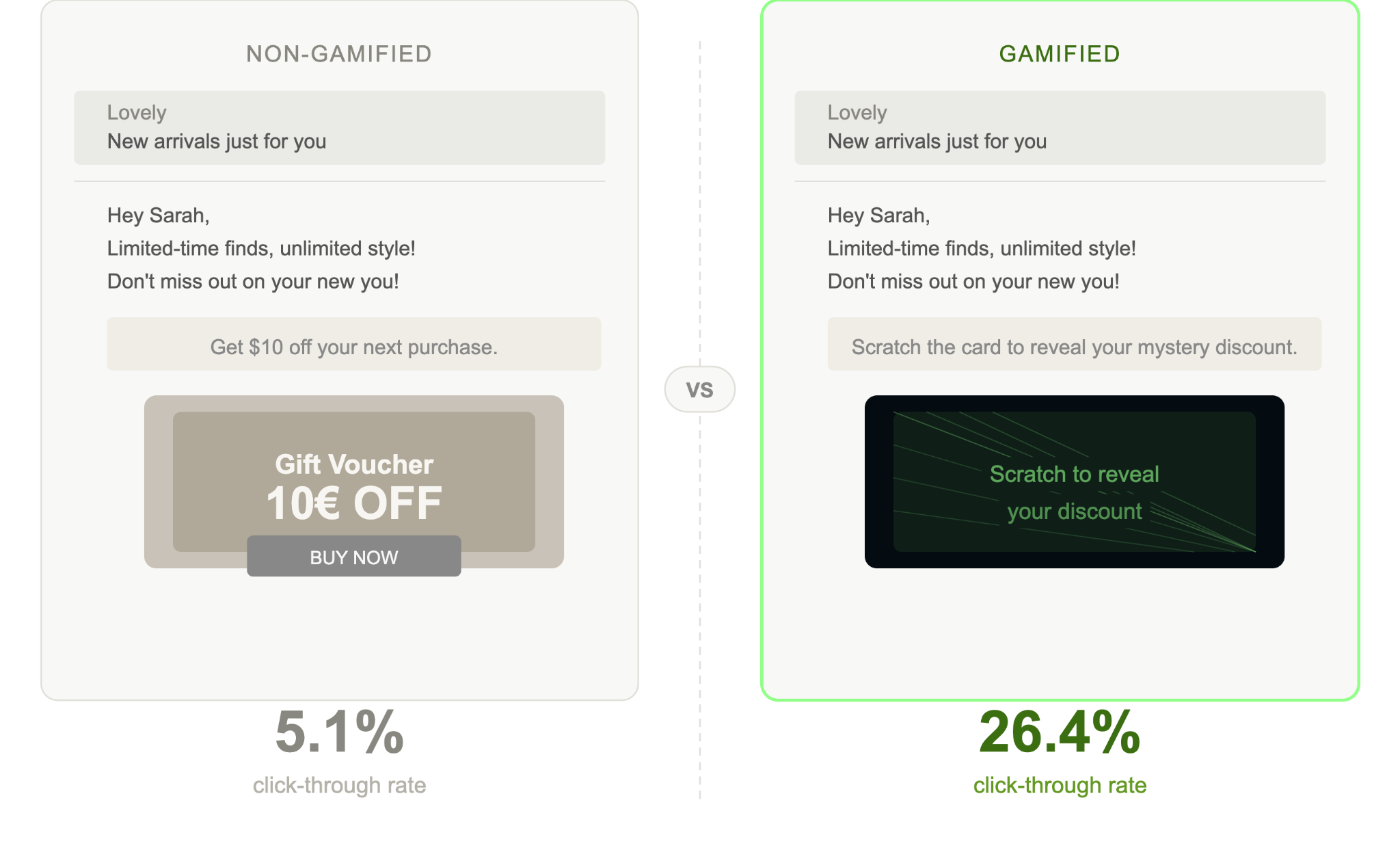
Here is one number that tends to land with operators. We ran an A/B test on the same promotional offer. One version used a scratch-card mechanic, where the player reveals the discount instead of just receiving it. The other delivered the discount flat. The scratch-card version pulled a 26.4% click-through rate. The flat version pulled 5.1%. Same offer. Same player. One change to how it was presented.
The way we build gamification at Optimove comes down to three things. Mechanics that feel native to the operator's brand, not pasted on. A library of 60+ games that deploy across web, app, and platform without a developer in the loop. And Optimove AI, our AI layer that decides which game the right player sees at the right moment in their lifecycle.
That last part is what most programs miss. Generic gamification is a novelty. Personalized gamification is a retention engine. If every player sees the same wheel spin, you are not building engagement. You are running a gimmick with a countdown clock.
Having channels is not a strategy. Connecting them is
Most operators I speak with already have the core channels: email, push, and increasingly SMS and WhatsApp. The problem is that they run each one separately. The player experience feels disconnected, and performance suffers.
That gap is measurable. Campaigns running across two or more channels outperform single-channel campaigns by 37%, with a 14% response rate versus 10.2%. Only 16% of the campaigns we studied were multi-channel, and that 16% generated significantly better ROI than the other 84%. Adding SMS to an email campaign alone can lift conversion by up to 429%.
Here is how I tell operators to think about the channel stack.
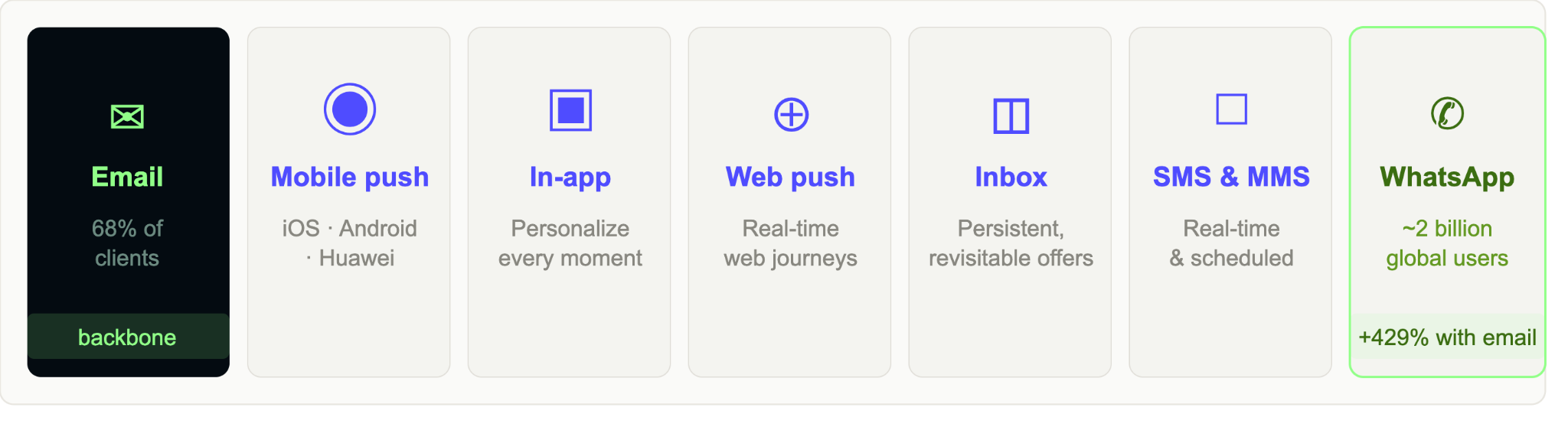
Email is the backbone. Email is natively used extensively by our client base. It is the backbone of an engagement program, supporting dynamic content, real-time and scheduled sends, and incrementality measurement that ties campaigns back to revenue rather than open rates.
Mobile push and in-app reach the player where they are. Native push across iOS, Android, and Huawei. Delivery timed to individual engagement history, not a broadcast schedule. Full creative control over in-app formats.
Web push and the Mobile and Web Inbox are the second chance. A persistent, revisitable place for offers a player did not act on the first time. Most operators do not have this, and it is a real drop-off point.
SMS, MMS, and WhatsApp are the real-time, high-attention channels. WhatsApp has nearly 2 billion users globally. Paired with Optimove's behavioral data, it becomes personalized and contextual at scale. Most operators in this space have not touched it yet. That window will not stay open.
I am not telling operators to be everywhere at once. I am telling them to pick two channels, connect them deliberately, and measure the difference. The operators who do that consistently are the ones on our best-performing client lists.
Where the Approvely partnership helps operators
Our partnership with Approvely can change how operators in this space should think about their stack.
Retention only works if the underlying business can move money. That sounds obvious. But I have watched operators invest seriously in engagement and get undermined by their payments infrastructure. Slow settlements. Compliance friction. Chargeback exposure. Onboarding delays that kill momentum. Those are not engagement problems. They are infrastructure problems, and no amount of gamification fixes them.
That is the side Approvely handles. Payments, instant settlements, stablecoin rails, and AML, KYC, and OFAC compliance from day one, with a 96.43% authorization rate, same-day onboarding, and zero-liability chargeback protection. For operators in gaming, betting, and sweepstakes, that is not a nice-to-have. It is the baseline for operating at scale.
Optimove handles what comes after the transaction. The gamification layer, the channel orchestration, and the AI decisioning that gives the player who just deposited a reason to come back.
For an operator, the benefit is simple. These are two different problems that live in the same operation. When payments and engagement work together, a player moves from deposit to active without hitting friction on either side. That is why we co-hosted the event with Approvely and SumSub. Operators needed to hear both parts of the conversation, not one at a time.
The operators who outperform over the next three years will be the ones who solve for payments and engagement together, not one and then the other.
I have been in this industry long enough to know the winners are not always the operators with the biggest budgets or the best product. They are the ones who stop treating retention as a department and start treating it as a discipline.
If you are still measuring success by deposits and sign-ups, you are measuring the wrong thing. The number that matters is how many of those players are still active sixty days from now.
To see how Optimove's engagement platform works with Approvely for your operation, visit optimove.com or reach out to the Approvely team directly.
Share this post


Guest Spotlight
.webp)